DECAQ / RESULT WORKSPACE
Your code. Your workload. Your result.
A NEW ROUTE TO QUANTUM COMPUTING
One DecaQ architecture.
Three ways to move forward.
A managed, paid cloud service for supported quantum workloads.
The DecaQ desktop system. Dedicated computation, closer to your data.
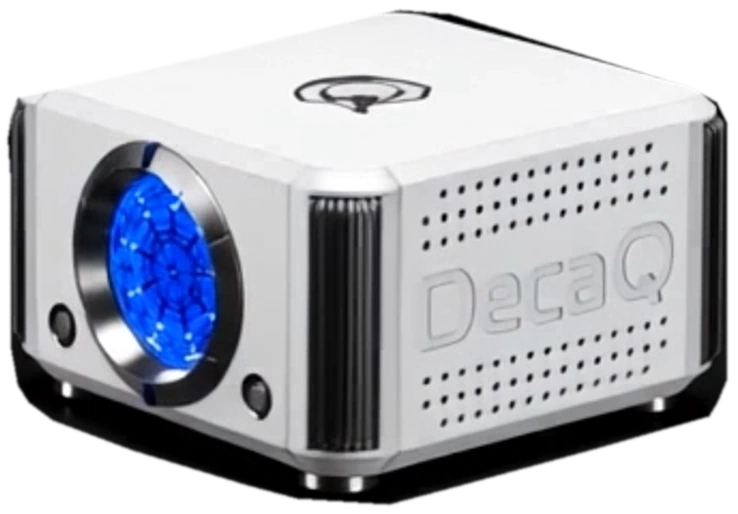 Q400 DESKTOP SYSTEM
For enterprises, research organizations, integrators and distributors.
*Capacity applies to supported DecaQ profiles. Workload, operator and precision limits depend on the selected family.
01 DECAQ CLOUD
From a defined workload to an inspectable result. Access DecaQ through a managed, paid service with profiles up to 400 logical qubits.
Recover an encoded binary relation through structured oracle computation.
Distinguish constant and balanced functions within a defined oracle problem.
Reconstruct phase through controlled evolution and sequential phase extraction.
Extract eigenphase information from structured controlled evolution.
Explore Hamiltonian and energy-minimization workloads using variational methods.
Work with structured combinatorial problems, including Max-Cut.
INSIDE THE WORKSPACE
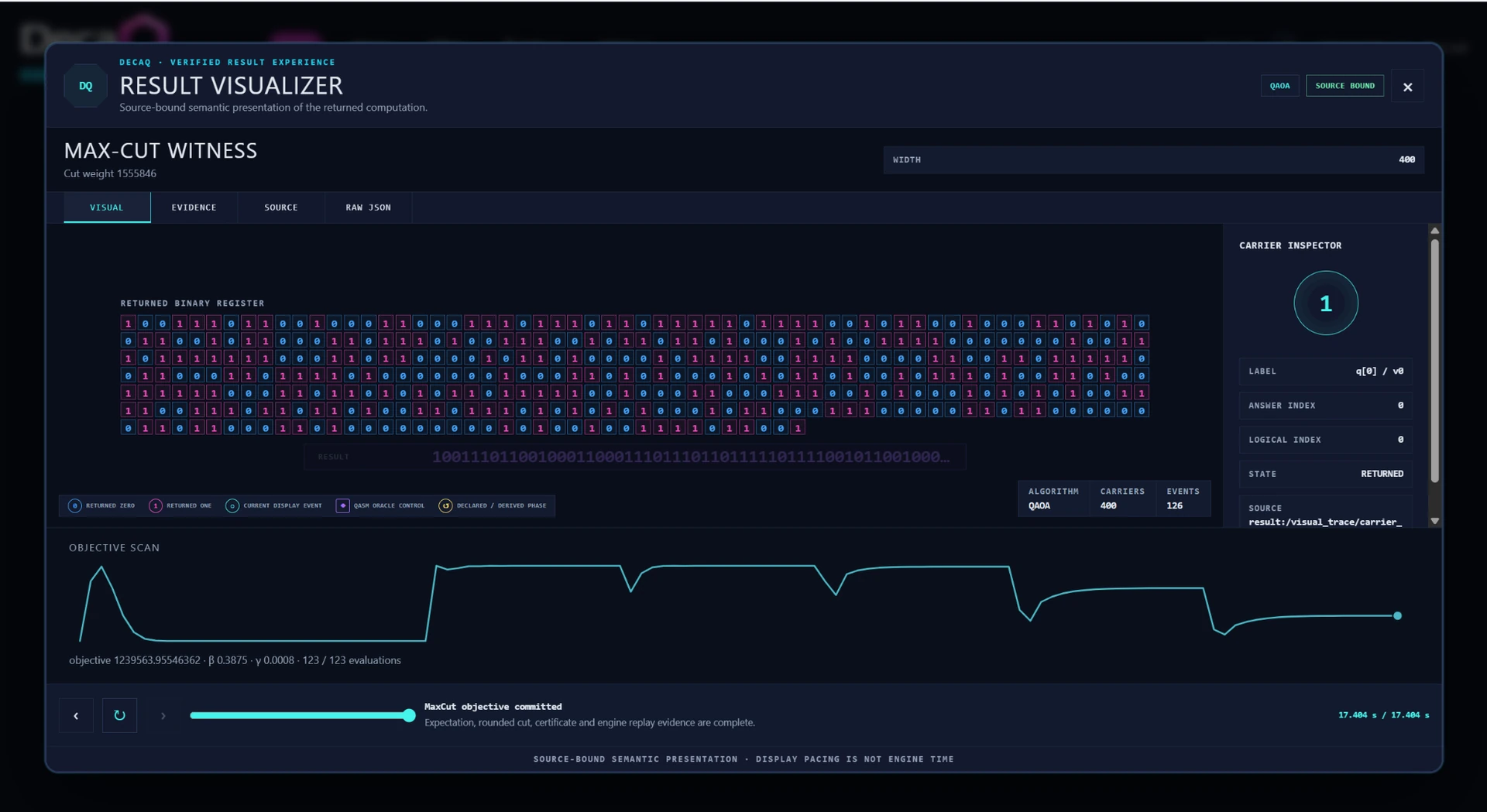
Inspect the returned register, explore the objective scan and follow the source associated with the result.
Actual interface image supplied by DecaQ. This is a captured result, not a live computation.
02 Q400 DESKTOP SYSTEM
DEDICATED. LOCAL. DECAQ.
Bring the DecaQ computational platform into your own environment. Q400 is a compact desktop system for supported logical quantum workloads.
A dedicated DecaQ environment.
Keep workloads close to your data.
Plan your cloud-to-local deployment.
Discuss profiles, integration and support.
Configuration, supported profiles and delivery arrangements are confirmed with the DecaQ team.
Start with a defined workload. Test the supported profile. Plan the local deployment with DecaQ.
03 CUSTOMERS & PARTNERS
Bring a computational requirement, an integration plan or a market opportunity. Let’s define the next step together.
Evaluate a real workload. Define the success criteria and explore cloud or local deployment.
Connect DecaQ to a wider environment, with a clear scope for interfaces, enablement and support.
Introduce DecaQ Cloud and Q400 to your market. Start a conversation about customers and territory.
LET’S BUILD THE NEXT STEP
Tell us what you want to compute, deploy or bring to market.
CONTACT / ONLINE INQUIRY
THE DECAQ NOTEBOOK
Explore the work behind the platform — from focused algorithm experiments to larger engineering and research programs.
120-logical-qubit echo evolution
Forward evolution, a perturbation and reverse evolution — a focused investigation of deep logical computation.
Finding a hidden period
Oracle-based hidden-period computation and the relations needed to recover an encoded structure.
A larger structured workload
Taking structured Max-Cut research beyond the current 400-logical-qubit service platform.
A route toward quantum chemistry
Hamiltonian structure, phase estimation and the engineering of a chemically motivated computation.
Think beyond expanded circuits
A program-representation and execution research direction for very large logical workloads.
From circuits to useful functions
Connecting application intent, operators, precision and selected outputs to a computational route.
Scope matters. Research, engineering milestones and development targets are labelled separately. Each note explains what is — and is not — being claimed.
THE DEVELOPMENT HORIZON
More logical capacity. Larger programs. A higher-level way to express what computation should do.
LOGICAL QUBITS · TARGET
Investigating an architecture that extends the DecaQ program toward hundreds of thousands of logical computational carriers.
GATES · PROGRAM-SCALE TARGET
Exploring representation and execution routes for very large logical programs, with explicit accounting of the work performed.
FUNCTION-LEVEL COMPUTATION
Connecting functions, operators, precision and selected observables to a defined computational pathway.
Development targets are not current service capacities, delivery commitments or measured execution results. Qubit capacity and program gate count are separate dimensions.

QUANTUM GEAR × QPE × FUNDAMENTAL PHYSICS
Quantum Gear connects application intent to computational functions. A parallel research direction explores structured operators, spectral models and discrete geometry through phase-estimation methods.
From useful functions to fundamental questions: a program of mathematical models, computational experiments and testable hypotheses.
Mathematical and computational research — not a claim of an experimentally established Theory of Everything.
FOR DEVELOPERS
Choose the algorithm family, define the computational contract and establish how you will verify the output.
BV · DJ · IPE · QPE · VQE · QAOA
Input, operators, width and precision.
Returned output, source and verification scope.
THIS IS WHERE YOUR NEXT WORKLOAD BEGINS.